
Quick Reference: Montessori Glossary of Terms
Updated: Aug 11
If you’re new to Montessori education, you may hear some unfamiliar terms when talking with your child’s teachers or reading school communications. Montessori uses certain words or phrases to describe how children learn, grow, and develop independence. Our Montessori in a Minute series is a homegrown resource built by Hudson Montessori School for our parents and community.
Here’s a simple guide to some of the most common Montessori terms you’ll hear at Hudson Montessori School.
Absorbent Mind
Maria Montessori believed that young children naturally absorb information from the world around them. From birth to about age six, children take in language, culture, social behaviors, and other experiences almost effortlessly simply by living and interacting with their environment.
Concrete to Abstract
Montessori children often touch and experience an idea using Montessori materials or “manipulatives” before they learn to represent it with symbols. For example, a child may use a Spindle Box of wooden sticks to understand quantities before learning to recognize and work with numbers on paper. Hands-on experience helps make abstract concepts easier to understand.
Control of Error
Many Montessori materials are designed so children can discover and correct their own mistakes. Instead of waiting for a teacher to tell them something is wrong, children can often see for themselves when something doesn't work. This builds problem-solving skills, independence, and confidence.

Coordination of Movement
Young children are constantly working to gain control of their bodies. Montessori activities give them opportunities to practice movements such as pouring, carrying, cutting, buttoning, and arranging objects. These activities build coordination, concentration, and physical independence.
Cosmic Education
Cosmic Education is the Montessori approach to helping elementary-age children understand their place in the larger world. Children explore the universe, Earth, human history, science, culture, and the interconnectedness of all living things through the “Great Lessons. The goal is to inspire curiosity and help children understand that they have a role to play in the world around them.
Freedom of Choice
Montessori classrooms give children meaningful choices about what they work on and when. This doesn't mean children can do whatever they want. Within clear boundaries, they learn to make thoughtful decisions, manage their time, and take responsibility for their choices.

Discipline From Within
Montessori leans on self-discipline rather than discipline imposed by an adult. While teachers guide children through challenges, particularly in a mixed-age classroom, a child can turn to older mentors as role models for appropriate behavior. Through role modeling from peers and teachers, children gradually learn to manage their behavior, make positive choices, respect others, and solve problems. Teachers guide this process and do not use a reward or punishment system.
Planes of Development
Montessori identified four major stages of development, or "planes," that children move through from birth to adulthood. Each stage has different physical, emotional, social, and intellectual needs. Montessori education is designed to meet children where they are developmentally and support them as they move toward greater independence.
Practical Life
Practical Life activities are everyday tasks that help children learn how to care for themselves, their classroom, and their community. Pouring, sweeping, washing, preparing food, buttoning clothing, and organizing materials may seem simple, but they build concentration, coordination, independence, and confidence.
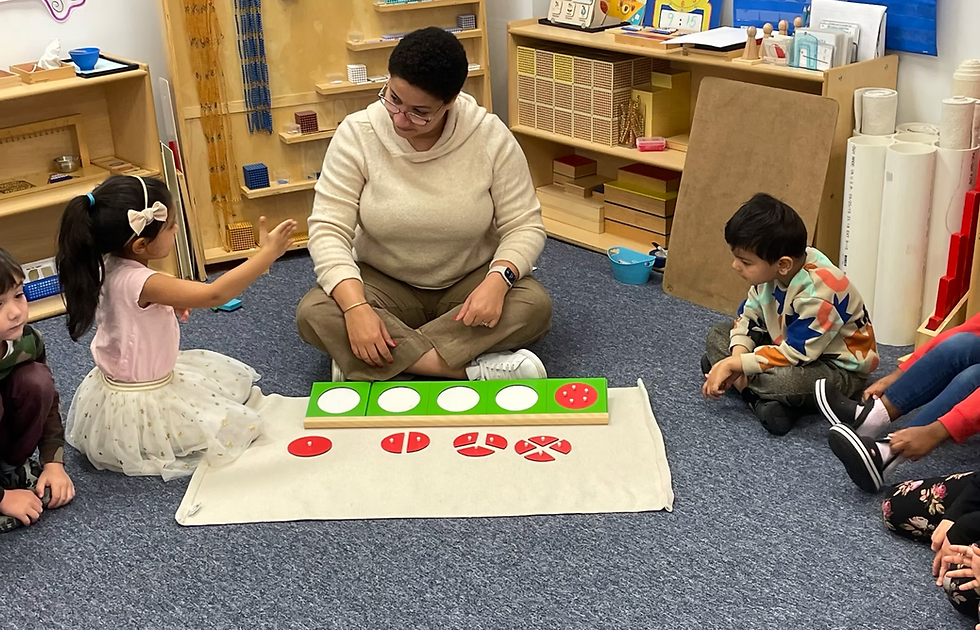
Grace and Courtesy
Grace and Courtesy lessons teach children how to interact respectfully with other people. Children learn practical social skills such as greeting someone, saying please and thank you, waiting their turn, asking for help, walking around someone's work, and resolving disagreements peacefully.
Independence
Montessori education is designed to help children gradually become capable of doing things for themselves. Rather than doing something for a child that they can learn to do themselves, Montessori teachers provide the right amount of guidance and support. It is the idea behind the Montessori phrase: "Help me do it myself." Our students gain self-pride for achieving their “I did it” moments.
Mathematical Mind
Montessori believed that humans have a natural ability to recognize patterns, quantities, relationships, and order. Montessori mathematics builds on this natural curiosity through hands-on experiences with numbers, quantities, patterns, measurement, and problem-solving before moving toward more abstract mathematical concepts.

Mixed Age Classroom
Montessori classrooms intentionally bring children of different ages together. Younger children learn by observing older students, while older children have opportunities to practice leadership and help others. Because children work at their own level, mixed-age classrooms encourage cooperation rather than competition.
Normalization
"Normalization" is a Montessori term for a child becoming increasingly focused, independent, confident, and engaged in purposeful activity. As children develop concentration and self-discipline, they often become happier and more capable learners who enjoy their work and contribute positively to their community.
Prepared Environment
The Montessori classroom is carefully designed with children in mind. Materials are organized, accessible, beautiful, and appropriately sized so children can choose and use them independently. Everything in the environment has a purpose, from the furniture to the learning materials to the way activities are arranged.

Presentation
A Montessori teacher doesn't simply tell a child how something works. Instead, the teacher gives a carefully demonstrated lesson, called a presentation. The teacher shows the child how to use a material or complete an activity, often slowly and precisely, and then gives the child time to practice independently.
Repetition
Children often repeat an activity many times, and Maria Montessori believed practice is an important part of learning and leads to mastery. A child may pour water over and over, build the same structure repeatedly, or practice a math activity long after they appear to "get it." Repetition helps children refine their movements, strengthen their understanding, and master new skills.
Sensitive Periods
Sensitive Periods are times when children are naturally especially interested in learning a particular skill or concept. A child may suddenly become fascinated with language, order, movement, or small details. Montessori classrooms provide materials and experiences that allow children to take advantage of these periods of intense interest and learning.
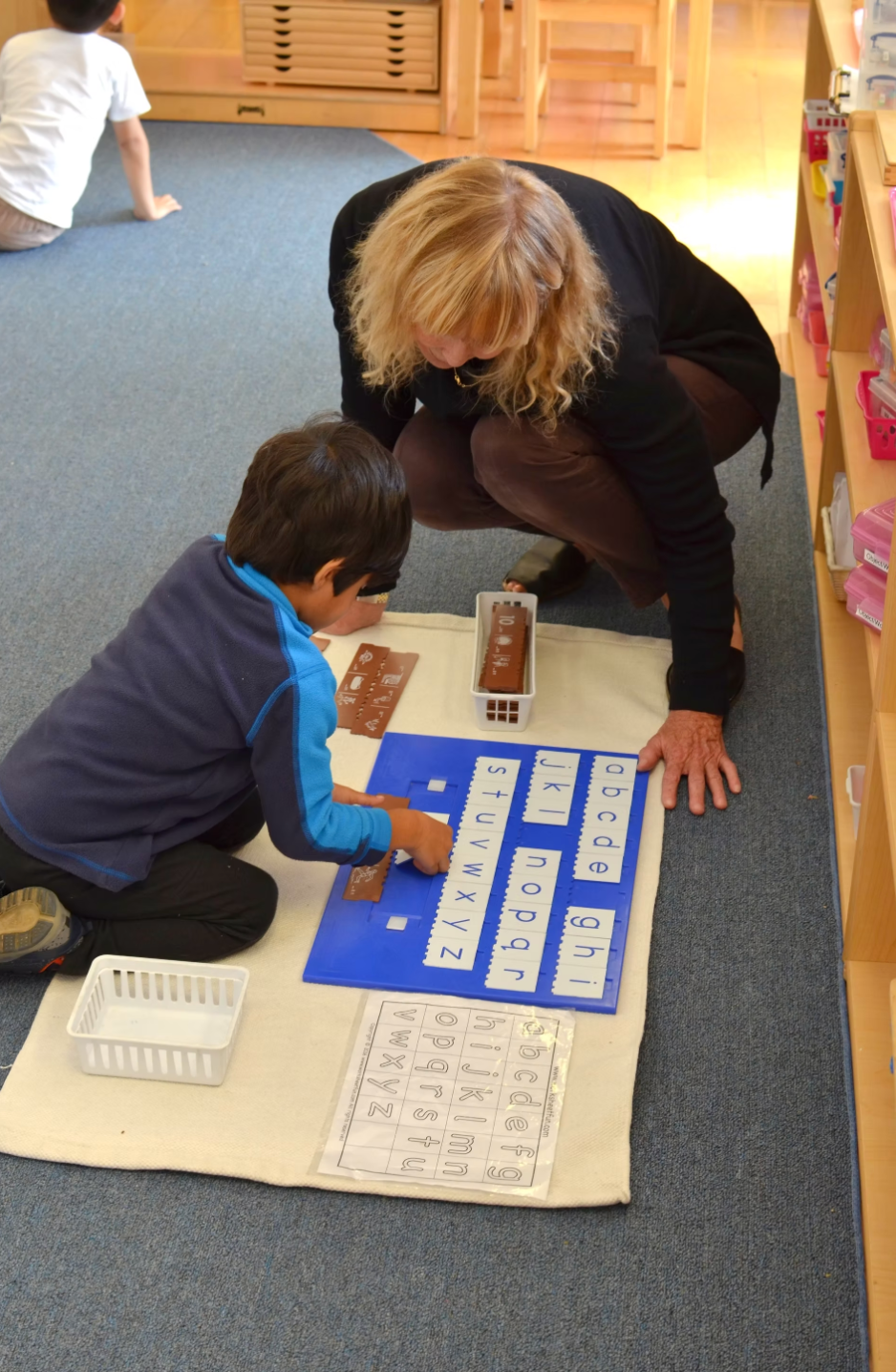
Sensorial Materials
Sensorial materials help children explore and understand the world through their senses. Montessori materials may isolate qualities such as size, shape, color, texture, sound, or weight, allowing children to focus on one characteristic at a time. Through hands-on exploration, children develop the ability to observe, compare, classify, and make distinctions.
Work
In Montessori, you may hear teachers refer to what children are doing as "work" rather than "play." This doesn't mean Montessori classrooms aren't fun. "Work" recognizes that children's activities are purposeful: they are building skills, solving problems, practicing independence, and making sense of their world. For a young child, this purposeful activity is their work. Younger children also relate to the term when they hear their own parents say, “They are going to work.” The child can relate to their parents by accomplishing hard tasks and having pride in “doing work” too.
Work Cycle
The Work Cycle is a longer, uninterrupted period in the Montessori day during which children can choose work, receive lessons, practice skills, and become deeply engaged. Montessori observed that children often need substantial time to settle into concentration, become absorbed in their work, deeply engaged by learning, and reach a satisfying stopping point.
Hudson Montessori School, located in downtown Jersey City, serves children from 18 months through 8th grade. The teachers use an interdisciplinary, theme-based learning approach grounded in Montessori philosophy and methodology to foster students' love of learning. The nationally certified STEM campus is the only one of its kind in New Jersey, featuring STEM-certified teachers who meet the highest standards set by the National Institute for STEM Education. The school welcomes parents to a school tour to learn more about its programs.


This glossary makes Montessori terms like independence and child-led learning much easier for families to understand. I’ll be sharing it with other parents—check out https://owl3d.pro
This Montessori glossary makes unfamiliar school terms much easier to understand, especially for families new to the language of independence and child-led learning. I’ll be sharing it with other parents—check out https://sloyd.pro
The Montessori in a Minute glossary is a helpful way to decode terms around independence and child-led learning, especially for families new to Montessori. I’ll be sharing this with other parents—check out https://inworld.pro
I’m having a small confusion with Lottery 7 Game. Does it require OTP verification every time, or only during the first login? Also, what should we do if OTP doesn’t arrive on time?